Godot Official Documentation RAG Classifier Schema and Architecture
Date: June 21, 2026
Purpose
Summarize the reference architecture for connecting the full collection of Godot official documentation through the flow JSONL -> PostgreSQL -> Retriever -> Validator -> Qwen 3.6. This document is not an implementation guide for creating training data, but a design guideline that defines how to structure the already‑collected official documentation Markdown in outputs/godot_docs_full/pages and turn it into a searchable evidence database.
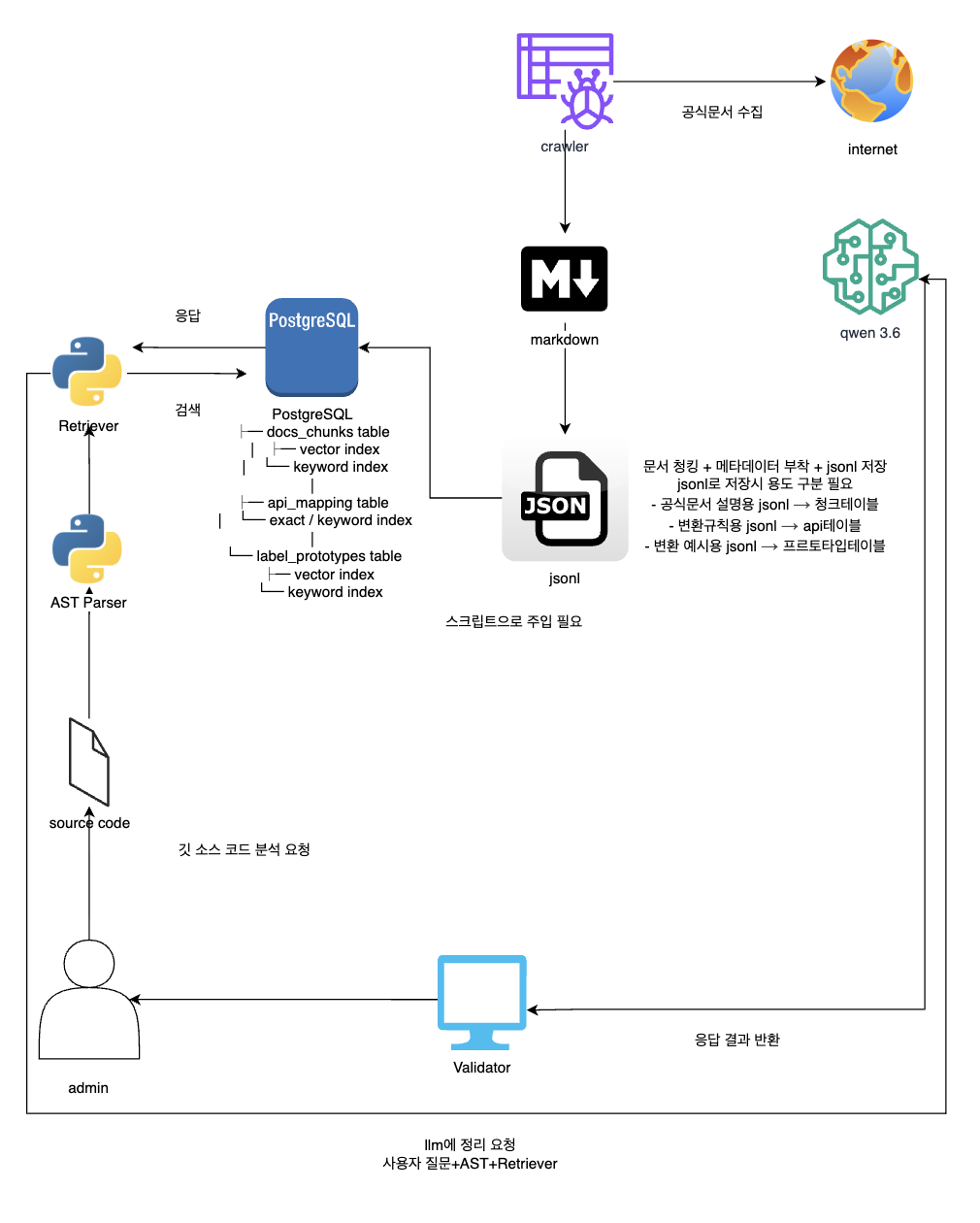
Current Input Data
The results of the documentation collection are located under the repository’s outputs/godot_docs_full.
| Path | Role |
|---|---|
outputs/godot_docs_full/pages/ |
Original Markdown for each Godot official documentation page |
outputs/godot_docs_full/manifest.json |
Original URL, local file path, collection status, byte size |
outputs/godot_docs_full/summary.json |
Summary of total collection count and validation |
outputs/godot_docs_full/urls.txt |
List of actually collected URLs |
outputs/godot_docs_full/searchindex_urls.txt |
Target URL list restored from the Sphinx search index |
outputs/godot_docs_full/failed.json |
List of collection failures |
outputs/godot_docs_full/missing_from_searchindex.txt |
Missing‑from‑search‑index list based on the search index |
Current baseline:
| Item | Value |
|---|---|
| Search index target pages | 1568 |
| Collected pages | 1570 |
| Page files | 1570 |
| Failed fetches | 0 |
| Missing from search index | 0 |
Full Pipeline
- The
crawlercollects the Godot official documentation from the internet. - The collection results are saved as page‑level Markdown files.
- The Markdown is normalized and metadata is attached, then converted to JSONL records.
- The JSONL is injected into PostgreSQL.
- PostgreSQL stores document chunks, API mappings, and label prototypes separately.
- When a user requests Godot source‑code analysis, the AST Parser structures the project code.
- The Retriever searches for evidence in PostgreSQL based on the user question and AST analysis results.
- The Validator bundles the question, AST results, and retrieved evidence and sends them to Qwen 3.6.
- Qwen 3.6 is not the final judge; it compiles an answer using the verified evidence.
- After the Validator checks the response’s evidence/format/forbidden patterns, it returns the result to the user.
Converting Markdown to JSONL
pages/*.md are human‑readable page sources, which are too large for RAG. Therefore, the conversion script splits pages into section/API‑member/example units and preserves the original URL and document type.
Common Normalization Rules
| Step | Processing |
|---|---|
| File load | Read Markdown based on file, url, status, bytes from manifest.json. |
| Body cleanup | Remove repeated headers, Sphinx UI text, broken anchor characters, and excessive whitespace. |
| Document type classification | Categorize into class_reference, tutorial, migration, engine_details, about, other based on URL and path. |
| Section splitting | Create chunk candidates based on heading hierarchy and Godot class reference patterns. |
| Code block preservation | GDScript, C#, shader, CLI examples are kept in code_blocks rather than removed from the body. |
| Provenance assignment | Attach original URL, file path, original hash, and conversion script version to every record. |
JSONL Outputs
| File | Purpose | Target Table |
|---|---|---|
work/godot_rag/jsonl/docs_chunks.jsonl |
Chunks for searching official documentation explanations/tutorials/references | docs_chunks |
work/godot_rag/jsonl/api_mapping.jsonl |
Godot 3 → 4 API changes, renames, deprecations, replacement rules | api_mapping |
work/godot_rag/jsonl/label_prototypes.jsonl |
Prototype examples for classification/translation/rejection/modification | label_prototypes |
work/godot_rag/jsonl/ingest_report.jsonl |
Warnings, skips, and quality‑check logs during conversion | For validation before DB injection |
docs_chunks.jsonl Schema
{
  "chunk_id": "godot-stable:classes/class_node.html#description:0001",
  "doc_version": "stable",
  "source_url": "https://docs.godotengine.org/en/stable/classes/class_node.html",
  "source_file": "outputs/godot_docs_full/pages/classes__class_node__....md",
  "source_sha256": "...",
  "doc_type": "class_reference",
  "symbol": "Node",
  "section_path": ["Node", "Description"],
  "heading": "Description",
  "content": "Nodes are Godot's building blocks...",
  "code_blocks": [],
  "language_tags": ["gdscript"],
  "godot_version_tags": ["4.x", "stable"],
  "api_symbols": ["Node", "_ready", "_process", "queue_free"],
  "token_count": 420,
  "metadata": {
    "status": "copied_old",
    "bytes": 12345
  }
}
Essential fields:
| Field | Description |
|---|---|
chunk_id |
Deterministic ID that does not change even if re‑executed |
doc_version |
Document version such as stable, 4.6, etc. |
source_url |
Original URL of the official documentation |
source_file |
Markdown path inside the repository |
source_sha256 |
Hash of the original Markdown |
doc_type |
Document type |
symbol |
Representative symbol when it is a class/API document |
section_path |
Title hierarchy |
content |
Main text subject to search and embedding |
code_blocks |
Array of code blocks extracted from the text |
api_symbols |
Godot API symbols detected in the text |
api_mapping.jsonl schema
{
  "mapping_id": "godot3-to-4:kinematicbody2d-to-characterbody2d",
  "source_api": "KinematicBody2D",
  "target_api": "CharacterBody2D",
  "change_type": "rename_or_replacement",
  "godot_from": "3.x",
  "godot_to": "4.x",
  "confidence": "verified_from_docs",
  "evidence_chunk_ids": [
    "godot-stable:tutorials/migrating/upgrading_to_godot_4.html#..."
  ],
  "match_terms": ["KinematicBody2D", "CharacterBody2D"],
  "notes": "Godot 4 character movement node replacement candidate.",
  "negative_patterns": ["do not suggest KinematicBody2D for Godot 4 projects"]
}
Principles:
| Item | Criteria |
|---|---|
confidence |
If there is official documentation, use verified_from_docs; otherwise, keep rule candidates as candidate. |
| Automatic extraction | Candidates can be generated from migration documents and class references. |
| Approval criteria | Rules used for training/labeling are promoted to approved status only after human review. |
| exact index | source_api, target_api, match_terms are exact search targets. |
label_prototypes.jsonl schema
{
  "prototype_id": "label:godot3-api-in-godot4:kinematicbody2d",
  "label": "godot3_api_in_godot4",
  "task_type": "version_classification",
  "input_pattern": "extends KinematicBody2D",
  "expected_finding": "Godot 3 style physics body API detected.",
  "recommended_action": "Use CharacterBody2D or CharacterBody3D depending on project dimension.",
  "evidence_mapping_ids": [
    "godot3-to-4:kinematicbody2d-to-characterbody2d"
  ],
  "evidence_chunk_ids": [],
  "severity": "high",
  "validator_rules": {
    "requires_ast_symbol": "KinematicBody2D",
    "forbidden_answer_terms": ["KinematicBody2D is recommended in Godot 4"]
  }
}
Label candidates:
| Label | Meaning |
|---|---|
godot4_valid_api |
Use of API valid for Godot 4 |
godot3_api_in_godot4 |
Godot 3 API mixed into a Godot 4 project |
deprecated_or_removed_api |
Use of deprecated/removed API |
migration_required |
Requires migration from Godot 3 → 4 |
ambiguous_version_signal |
Insufficient or conflicting version evidence |
non_godot_noise |
Data unrelated to Godot such as Python/web/Unity |
unsafe_or_obfuscated_code |
Obfuscated, control characters, potentially malicious code |
Draft PostgreSQL schema
PostgreSQL assumes the use of pgvector. Keyword search uses tsvector or a trigram index.
docs_chunks
| Column | Type | Description |
|---|---|---|
id |
bigserial primary key |
Internal ID |
chunk_id |
text unique not null |
Deterministic ID of the JSONL |
doc_version |
text not null |
Document version |
source_url |
text not null |
Official documentation URL |
source_file |
text not null |
Markdown file path |
source_sha256 |
text not null |
Original hash |
doc_type |
text not null |
Document type |
symbol |
text |
Representative API/class symbol |
section_path |
jsonb not null |
Heading hierarchy |
heading |
text |
Current chunk heading |
content |
text not null |
Searchable body |
code_blocks |
jsonb not null default '[]' |
Code blocks |
api_symbols |
text[] not null default '{}' |
Extracted symbols |
metadata |
jsonb not null default '{}' |
Additional metadata |
embedding |
vector |
Embedding |
search_tsv |
tsvector |
Keyword search |
created_at |
timestamptz default now() |
Insertion timestamp |
Indexes:
| Index | Purpose |
|---|---|
unique(chunk_id) |
Prevent duplicate insertion |
ivfflat/hnsw(embedding) |
Semantic search |
gin(search_tsv) |
Keyword search |
gin(api_symbols) |
API symbol filter |
btree(doc_type, symbol) |
Class/API document filter |
api_mapping
| Column | Type | Description |
|---|---|---|
id |
bigserial primary key |
Internal ID |
mapping_id |
text unique not null |
Deterministic ID |
source_api |
text not null |
Original/problematic API |
target_api |
text |
Recommended API |
change_type |
text not null |
rename, removed, behavior_change, etc. |
godot_from |
text |
Source version |
godot_to |
text |
Target version |
confidence |
text not null |
Evidence level |
status |
text not null default 'candidate' |
candidate, approved, rejected |
evidence_chunk_ids |
text[] not null default '{}' |
Official documentation evidence chunks |
match_terms |
text[] not null default '{}' |
Search keywords |
notes |
text |
Description |
negative_patterns |
jsonb not null default '[]' |
Forbidden patterns |
Indexes:
| Index | Purpose |
|---|---|
unique(mapping_id) |
Prevent duplicates |
btree(source_api) |
Exact lookup |
btree(target_api) |
Reverse lookup |
gin(match_terms) |
Keyword search |
btree(status, confidence) |
Approval rule filter |
label_prototypes
| Column | Type | Description |
|---|---|---|
id |
bigserial primary key |
Internal ID |
prototype_id |
text unique not null |
Deterministic ID |
label |
text not null |
Classification label |
task_type |
text not null |
classification, migration_fix, patch_generation, etc. |
input_pattern |
text not null |
Detection pattern |
expected_finding |
text not null |
Expected determination |
recommended_action |
text |
Recommended action |
evidence_mapping_ids |
text[] not null default '{}' |
API mapping evidence |
evidence_chunk_ids |
text[] not null default '{}' |
Document chunk evidence |
severity |
text not null |
low, medium, high |
validator_rules |
jsonb not null default '{}' |
Validation rules |
embedding |
vector |
Similar case search |
search_tsv |
tsvector |
Keyword search |
Indexes:
| Index | Purpose |
|---|---|
unique(prototype_id) |
Prevent duplicates |
btree(label, task_type) |
Lookup by label |
ivfflat/hnsw(embedding) |
Similar label search |
gin(search_tsv) |
Keyword search |
AST Parser input/output
The AST Parser converts user source code into a searchable structure before passing it directly to an LLM. Initial targets are .gd, .tscn, project.godot.
Input
| Input | Description |
|---|---|
| User question | e.g., “Check if this project is safe for Godot 4” |
| Source code files | .gd, .tscn, .tres, project.godot |
| Project structure | File paths, scene connections, resource paths |
Output schema
{
  "project_id": "local-analysis-...",
  "godot_project": {
    "config_version": 5,
    "features": ["4.4", "Forward Plus"]
  },
  "files": [
    {
      "path": "scripts/player.gd",
      "language": "gdscript",
      "extends": "CharacterBody2D",
      "class_name": "Player",
      "symbols": ["CharacterBody2D", "Input", "move_and_slide"],
      "annotations": ["@onready"],
      "version_signals": ["godot4_annotation_syntax"],
      "diagnostics": []
    }
  ],
  "version_evidence": {
    "godot4": ["config_version=5", "@onready"],
    "godot3": []
  }
}
Initial extraction fields:
| Field | Purpose |
|---|---|
extends |
Determine Node/API version |
class_name |
Project internal symbol mapping |
annotations |
Godot 4 signals such as @onready, @export, etc. |
legacy_keywords |
Godot 3 signals such as onready var, export var, KinematicBody, etc. |
method_calls |
Documentation search and API mapping lookup |
scene_dependencies |
Scene/script connection verification |
resource_paths |
Missing resources and asset connection verification |
Retriever operation
The Retriever is a layer that selects evidence before the LLM.
- Extract the intent and target task from the user question.
- Retrieve API symbols, version signals, and file paths from the AST Parser results.
- Perform an exact lookup in
api_mappingfirst. - Perform API symbol filtering + keyword search + vector search together in
docs_chunks. - Retrieve similar labels and validation rules from
label_prototypes. - Sort the search results into evidence bundles.
Evidence bundles:
{
  "query_id": "analysis-...",
  "task_type": "version_classification",
  "ast_summary": {},
  "doc_evidence": [],
  "api_mapping_evidence": [],
  "label_evidence": [],
  "retrieval_scores": {
    "exact_api_hits": 2,
    "keyword_hits": 8,
    "vector_hits": 12
  }
}
Separation of Roles between Validator and Qwen 3.6
Qwen 3.6 is a model that reads retrieved evidence and organizes the answer. The final label, evidence adoption, and prohibited‑pattern verification are handled by the Validator.
| Component | Responsibility |
|---|---|
| Retriever | Search for relevant official documents / API mappings / label evidence |
| Validator | Verify missing evidence, prohibited patterns, output JSON format |
| Qwen 3.6 | Organize explanations readable to the user, revision directions, code suggestions |
Items the Validator checks:
| Item | Criterion |
|---|---|
| Evidence ID existence | The document / mapping / label ID used in the answer must be present in the actual search results. |
| Godot 4 standard | The Godot 4 project must not recommend the Godot 3 API. |
| Uncertainty indication | If evidence is insufficient, a definitive judgment is prohibited and it should be set to ambiguous_version_signal. |
| Code suggestion verification | Suggested code must not conflict with the detected project dimension (2D/3D). |
| JSON format | Internal pipeline output must be parsable JSON. |
Injection Order
- Check
outputs/godot_docs_full/summary.jsonandfailed.json. - Load
manifest.jsonandpages/*.md. - Create a Markdown normalization report.
- Generate
docs_chunks.jsonl. - Produce
api_mapping.jsonlcandidates from migration/class documents. - Create
label_prototypes.jsonlfrom approved rules and representative cases. - Upsert only records that pass JSONL schema validation into PostgreSQL.
- Generate embeddings and update the vector index.
- Refresh the keyword index and the exact index.
- Validate Retriever results with sample questions.
Quality Assurance Checklist
| Stage | Pass Criteria |
|---|---|
| Collection verification | failed_count = 0, missing_from_searchindex = 0 |
| Markdown normalization | No empty chunks, original URLs preserved |
| JSONL verification | Every line is JSON‑parseable, required fields present |
| Duplicate verification | No duplicates among chunk_id, mapping_id, prototype_id |
| Evidence verification | api_mapping.evidence_chunk_ids actually exist in docs_chunks |
| Search verification | Representative API questions return both exact hit and docs hit |
| Response verification | Qwen responses contain no unsupported assertions and do not recommend Godot 3 API |
Implementation Priorities
- Write a report analyzing the structure of
pages/*.md. - Write a conversion script for
docs_chunks.jsonl. - Write a JSONL schema validation script.
- Write PostgreSQL DDL.
- Inject
docs_chunksand verify search. - Generate
api_mappingcandidates and draft the manual approval flow. - Draft the initial label set for
label_prototypes. - Extract minimal fields with the AST Parser.
- Output Retriever evidence bundles.
- Connect the Validator + Qwen 3.6 response‑organizing loop.
Core Principles
- Preserve the original Markdown of official documents without modification.
- Treat JSONL as a reproducible intermediate artifact.
- The database must retain the original path, original URL, hash, and conversion script version.
- Prevent the LLM from inventing labels.
- Godot 3/4 determination is made by combining AST signals, API mappings, and official‑document evidence.
- Uncertain candidates are kept in a
candidatestate rather than being used directly as training data. - Qwen 3.6 is the answer organizer; the judgment criteria belong to the Retriever and Validator.
Next Tasks
The next step is to perform a sample analysis of the Markdown structure in outputs/godot_docs_full/pages. Because class reference, migration, and tutorial documents have different structures, we need to first decide chunking strategies per document type rather than forcing a single chunking rule.