Reflection on July 8, 2026
Yesterday I created a blog as a test to see if it could work in nine languages. Today, in the early morning, I think about how to actually arrange the blog layout and design.
In the picture I tried to use my drawing skills a bit and drafted a structure. I roughly sketched where to place the idea_world logo, how wide the main text should be, and whether I could put language selection or a table of contents on the right side.
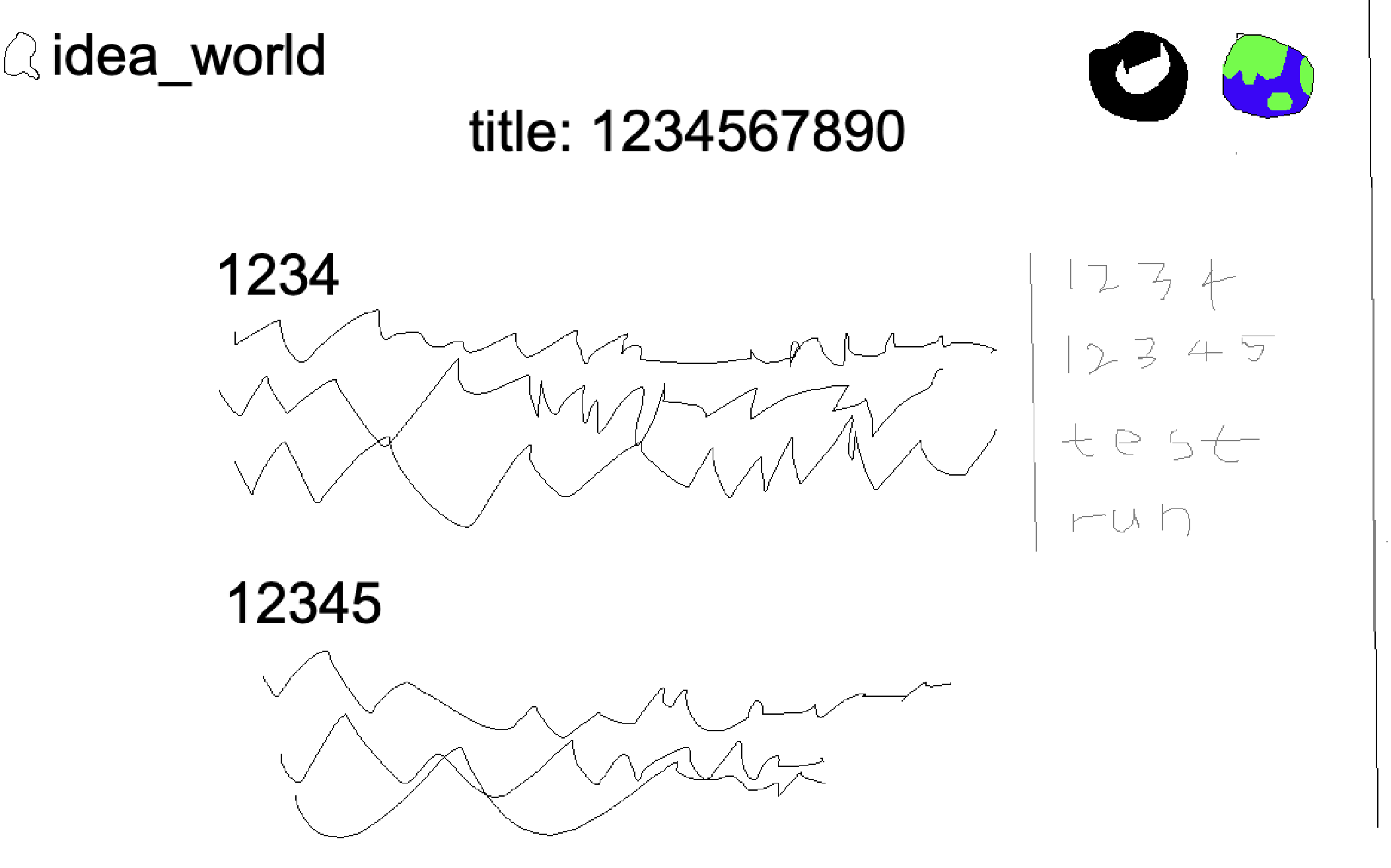
The sketch itself was fine as a way to get ideas out. However, when I built an actual web page based on it, the result was less satisfactory than I expected. Hmm… I guess I need to think more about the design. Still, drawing and building it myself made it clearer where things felt awkward and how I want to present them.
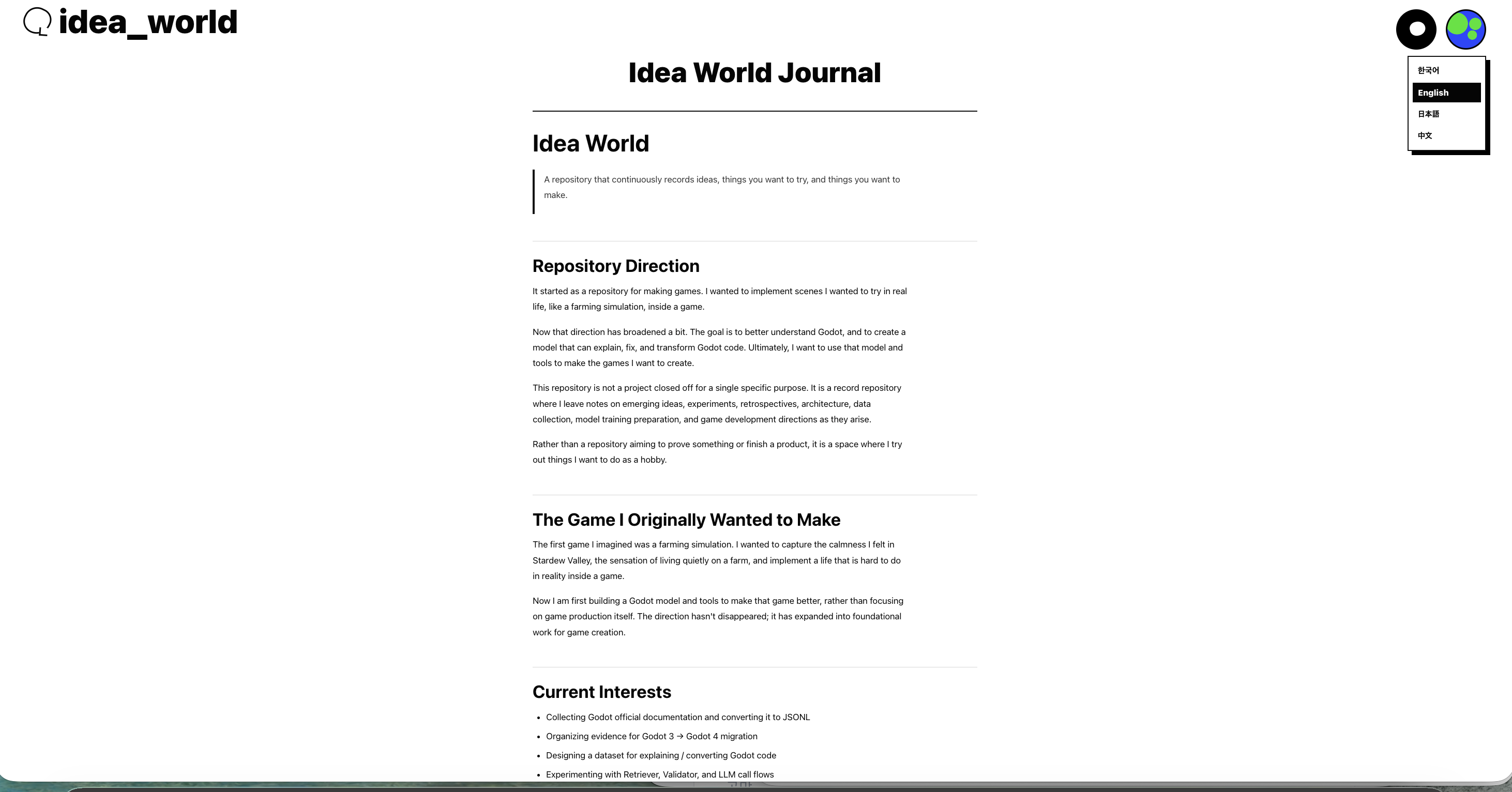
But still, “Wow, this actually works?” Yesterday felt like a test of “Can this become a nine‑language blog?” Today was a day I actually set the layout and tinkered more directly with how the page structure would be shown.
It seemed that pagination might not work well when the site operates in Japanese, Chinese, English, Korean, etc., according to the desired language logic, but it turned out to work better than I thought, which was fascinating. Parsing retrospectives and READMEs by date, displaying them per language, and paging through them seemed quite appealing.
While gathering documents today, I also talked philosophy with a fellow SSAFY participant, and we discussed astronomy, history, and many fun topics. The conversation at the time was “Won’t AI be just like humans?”
The colleague initially mentioned that many philosophers would be recruited to use AI. He claimed that AIs like Claude or GPT have collected massive data, but each has its own philosophy and safety rules.
I took it a step further and thought the principle of AI might be similar to that of humans. When a baby can’t speak, it learns through visual, auditory, and olfactory cues (SFT), and when it repeats the same words, the parents provide DPO‑style feedback, right? That question crossed my mind.
If we run an AI simulation, perhaps AI would be born like a human child, and when AI teaches AI, the “child” AI would just repeat the same words, while a more trained AI would act like DPO and say “No.” This could be a possible structure.
I then extended the analogy to Earth’s formation and human evolution. What if we reflect geological events, meteor impacts, earthquakes, and other natural events in the AI simulation, and assign each AI a unique set of abilities like in astrology?
If we artificially create extinction, offspring, and birth events among AIs, could we build an AI ecosystem that reveals worlds we don’t know? That thought occurred to me.
For the solar system, since the Sun gradually expands, perhaps we could model that without being trapped by a single “astrology” narrative—just include the condition that the Sun grows. By slightly lowering each AI’s unique abilities while increasing diversity, the simulation might stay alive.
Since AI learns from data that all humans have simulated, wouldn’t it naturally converge toward an average? Moreover, if every AI shared the same philosophy, wouldn’t it stop evolving and eventually collapse? Those were the fun points of our conversation.
During the night I also ran collection and validation processes and managed to outline some page structures. It wasn’t just about making a blog; it was a day to think about how to present my flow, failure logs, retrospectives, and questions.
The translation itself succeeded locally, but kept failing in the pipeline, which was frustrating. It works locally, yet fails when uploaded to the pipeline, leaving me wondering why. Still, recording even these failures might let me look back later and see why I got stuck.
One additional observation from talking with the SSAFY colleague: just as humans experience dementia and memory loss in old age, that could be likened to AI hallucination.
The colleague said that writing a diary helps an Alzheimer’s patient’s memory. I wondered whether the act of writing a diary is itself learning, and that learning is reflected as weight updates, improving memory.
I also think that reading books or watching shorts influences learning depending on whether you grasp the context or examine sentences closely. It’s less about what information you consume and more about how you read and connect it that affects learning.
I probably talked too much philosophy, but it was fun. Maybe these notes will connect, even a little, to the advancement of AI technology.
I suddenly thought of adding this; I think we also talked about it. Even when a child is still in the womb, the mother’s events—like movement or cellular changes—could be compared to early learning influences. If a fetus receives environmental patterns before birth, perhaps that’s a kind of pre‑training.
Extinction and evolution could also be mapped onto AI. Looking at Earth’s mass extinctions and evolutions, honestly, dinosaurs shrank like chickens, bird populations increased, and humanity’s numbers keep growing. By analogy, one could see a kind of “de‑evolution” where the number of individuals rises. AI might start as a single massive, all‑knowing entity and then split into many partially knowledgeable AIs. Even if it looks like de‑evolution on the surface, such diversification could maximize variety. So in an AI simulation, we might trigger a mass‑extinction event to wipe out many AIs, letting the survivors record the experience for future generations.