Godot 官方文档 RAG 分类器模式与架构
编写日期:2026 年 6 月 21 日
目的
整理将 Godot 官方文档完整收集版通过 JSONL -> PostgreSQL -> Retriever -> Validator -> Qwen 3.6 流程连接的基准架构。本文档并非用于直接生成训练数据的实现文档,而是定义如何将已聚集在 outputs/godot_docs_full/pages 中的官方文档 Markdown 进行结构化并构建可检索的依据数据库的设计基准。
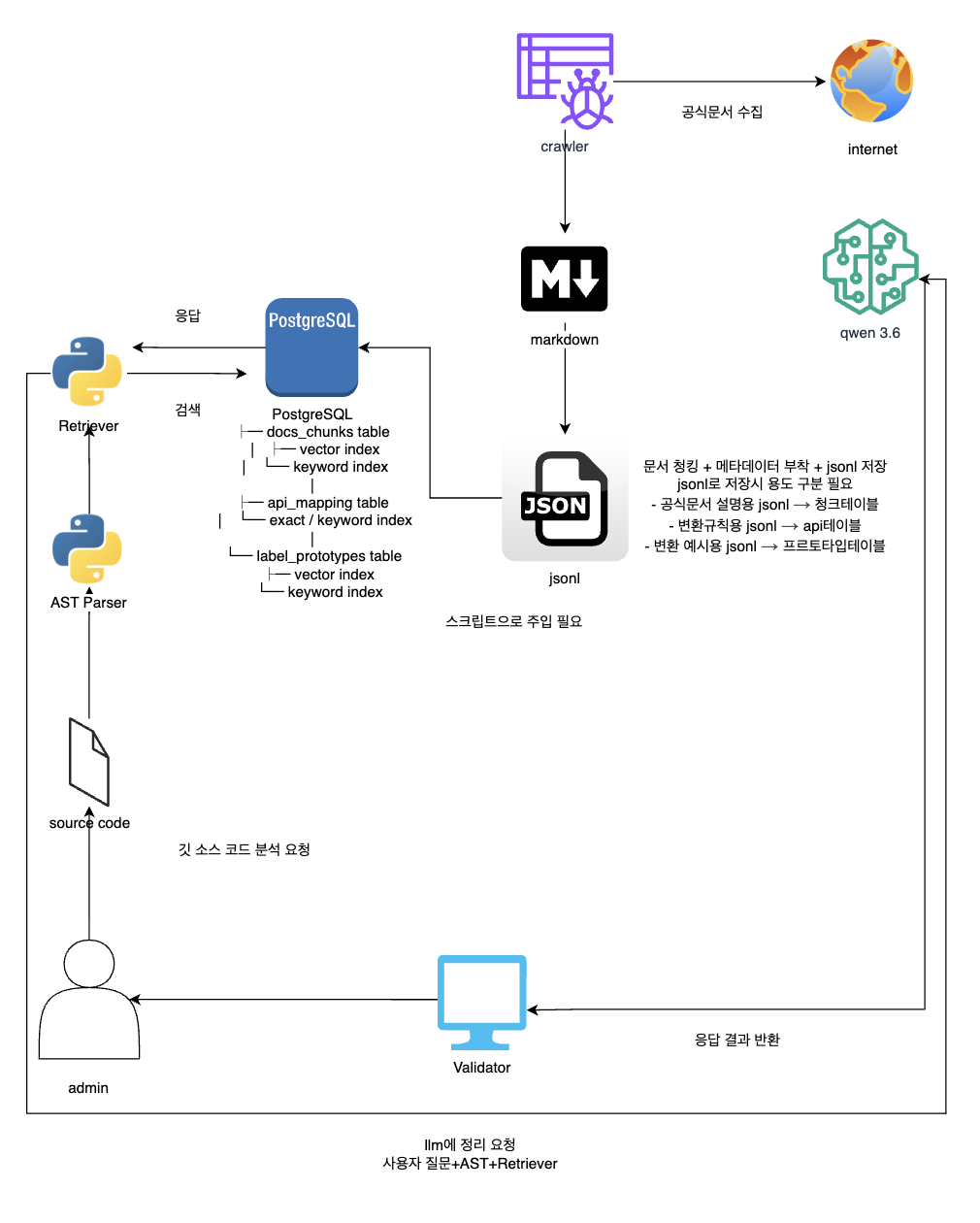
当前输入数据
官方文档收集结果位于仓库的 outputs/godot_docs_full 下。
| 路径 | 作用 |
|---|---|
outputs/godot_docs_full/pages/ |
Godot 官方文档各页面的 Markdown 原始文件 |
outputs/godot_docs_full/manifest.json |
原始 URL、本地文件路径、收集状态、字节大小 |
outputs/godot_docs_full/summary.json |
整体收集计数与验证摘要 |
outputs/godot_docs_full/urls.txt |
实际收集的 URL 列表 |
outputs/godot_docs_full/searchindex_urls.txt |
从 Sphinx 搜索索引恢复的目标 URL 列表 |
outputs/godot_docs_full/failed.json |
收集失败列表 |
outputs/godot_docs_full/missing_from_searchindex.txt |
基于搜索索引的缺失列表 |
当前基准线:
| 项目 | 值 |
|---|---|
| Search index target pages | 1568 |
| Collected pages | 1570 |
| Page files | 1570 |
| Failed fetches | 0 |
| Missing from search index | 0 |
整体流水线
crawler从互联网收集 Godot 官方文档。- 将收集结果保存为页面级别的 Markdown。
- 对 Markdown 进行规范化并附加元数据,转换为 JSONL 记录。
- 将 JSONL 注入 PostgreSQL。
- PostgreSQL 将文档块、API 映射、标签原型分离存储。
- 当用户请求分析 Godot 源代码时,AST Parser 对项目代码进行结构化。
- Retriever 根据用户问题和 AST 分析结果在 PostgreSQL 中检索依据。
- Validator 将问题、AST 结果、检索依据组合后传递给 Qwen 3.6。
- Qwen 3.6 并非最终裁决者,而是使用已验证的依据整理答案。
- Validator 检查响应的依据/格式/禁用模式后返回给用户。
从 Markdown 转换为 JSONL
pages/*.md 是适合人阅读的页面原始文件,但对 RAG 来说粒度过大。因此转换脚本将页面拆分为章节/API 成员/示例单元,并保留原始 URL 与文档类型。
通用规范化规则
| 步骤 | 处理 |
|---|---|
| 文件加载 | 根据 manifest.json 中的 file、url、status、bytes 读取 Markdown。 |
| 正文整理 | 去除重复标题、Sphinx UI 文本、损坏的锚点字符、过多空白。 |
| 文档类型划分 | 根据 URL 与路径将文档划分为 class_reference、tutorial、migration、engine_details、about、other。 |
| 章节拆分 | 依据标题层级和 Godot 类引用模式生成块候选。 |
| 代码块保留 | GDScript、C#、shader、CLI 示例不从正文中移除,单独保存在 code_blocks 中。 |
| provenance 赋予 | 为所有记录添加原始 URL、文件路径、原始哈希、转换脚本版本。 |
JSONL 输出物
| 文件 | 目的 | 目标表 |
|---|---|---|
work/godot_rag/jsonl/docs_chunks.jsonl |
官方文档说明/教程/参考检索用块 | docs_chunks |
work/godot_rag/jsonl/api_mapping.jsonl |
Godot 3 → 4 API 变更、重命名、弃用、替代规则 | api_mapping |
work/godot_rag/jsonl/label_prototypes.jsonl |
分类/转换/拒绝/修改示例原型 | label_prototypes |
work/godot_rag/jsonl/ingest_report.jsonl |
转换过程中的警告、跳过、质量检查日志 | 用于 DB 注入前的验证 |
docs_chunks.jsonl 模式
{
  "chunk_id": "godot-stable:classes/class_node.html#description:0001",
  "doc_version": "stable",
  "source_url": "https://docs.godotengine.org/en/stable/classes/class_node.html",
  "source_file": "outputs/godot_docs_full/pages/classes__class_node__....md",
  "source_sha256": "...",
  "doc_type": "class_reference",
  "symbol": "Node",
  "section_path": ["Node", "Description"],
  "heading": "Description",
  "content": "Nodes are Godot's building blocks...",
  "code_blocks": [],
  "language_tags": ["gdscript"],
  "godot_version_tags": ["4.x", "stable"],
  "api_symbols": ["Node", "_ready", "_process", "queue_free"],
  "token_count": 420,
  "metadata": {
    "status": "copied_old",
    "bytes": 12345
  }
}
必填字段:
| 字段 | 说明 |
|---|---|
chunk_id |
即使重新运行也不会改变的确定性 ID |
doc_version |
如 stable, 4.6 等文档版本 |
source_url |
官方文档原始 URL |
source_file |
仓库内 Markdown 路径 |
source_sha256 |
原始 Markdown 哈希 |
doc_type |
文档类型 |
symbol |
当为 class/API 文档时的代表符号 |
section_path |
标题层级 |
content |
用于搜索和嵌入的正文 |
code_blocks |
从正文中提取的代码块数组 |
api_symbols |
正文中检测到的 Godot API 符号 |
api_mapping.jsonl 架构
{
  "mapping_id": "godot3-to-4:kinematicbody2d-to-characterbody2d",
  "source_api": "KinematicBody2D",
  "target_api": "CharacterBody2D",
  "change_type": "rename_or_replacement",
  "godot_from": "3.x",
  "godot_to": "4.x",
  "confidence": "verified_from_docs",
  "evidence_chunk_ids": [
    "godot-stable:tutorials/migrating/upgrading_to_godot_4.html#..."
  ],
  "match_terms": ["KinematicBody2D", "CharacterBody2D"],
  "notes": "Godot 4 character movement node replacement candidate.",
  "negative_patterns": ["do not suggest KinematicBody2D for Godot 4 projects"]
}
原則:
| 項目 | 標準 |
|---|---|
confidence |
有官方文件依據時為 verified_from_docs,規則候選項為 candidate。 |
| 自動提取 | 可以從 migration 文檔和 class reference 中生成候選項。 |
| 核准標準 | 用於學習/標註的規則僅在人工審核後才提升為 approved 狀態。 |
| exact index | source_api、target_api、match_terms 為精確搜索對象。 |
label_prototypes.jsonl 結構
{
  "prototype_id": "label:godot3-api-in-godot4:kinematicbody2d",
  "label": "godot3_api_in_godot4",
  "task_type": "version_classification",
  "input_pattern": "extends KinematicBody2D",
  "expected_finding": "Godot 3 style physics body API detected.",
  "recommended_action": "Use CharacterBody2D or CharacterBody3D depending on project dimension.",
  "evidence_mapping_ids": [
    "godot3-to-4:kinematicbody2d-to-characterbody2d"
  ],
  "evidence_chunk_ids": [],
  "severity": "high",
  "validator_rules": {
    "requires_ast_symbol": "KinematicBody2D",
    "forbidden_answer_terms": ["KinematicBody2D is recommended in Godot 4"]
  }
}
标签候选:
| 标签 | 含义 |
|---|---|
godot4_valid_api |
基于 Godot 4 的有效 API 使用 |
godot3_api_in_godot4 |
Godot 4 项目中混入了 Godot 3 API |
deprecated_or_removed_api |
使用了已删除/废弃的 API |
migration_required |
需要从 Godot 3 迁移到 4 |
ambiguous_version_signal |
版本判断依据不足或冲突 |
non_godot_noise |
与 Godot 无关的数据(Python、Web、Unity 等) |
unsafe_or_obfuscated_code |
混淆、控制字符、疑似恶意代码 |
PostgreSQL 模式草案
PostgreSQL 默认使用 pgvector。关键词搜索同时使用 tsvector 或 trigram 索引。
docs_chunks
| 列 | 类型 | 说明 |
|---|---|---|
id |
bigserial primary key |
内部 ID |
chunk_id |
text unique not null |
JSONL 的决定性 ID |
doc_version |
text not null |
文档版本 |
source_url |
text not null |
官方文档 URL |
source_file |
text not null |
Markdown 文件路径 |
source_sha256 |
text not null |
原始哈希 |
doc_type |
text not null |
文档类型 |
symbol |
text |
代表 API / class 符号 |
section_path |
jsonb not null |
标题层级 |
heading |
text |
当前块标题 |
content |
text not null |
可搜索正文 |
code_blocks |
jsonb not null default '[]' |
代码块 |
api_symbols |
text[] not null default '{}' |
提取的符号 |
metadata |
jsonb not null default '{}' |
其他元数据 |
embedding |
vector |
向量嵌入 |
search_tsv |
tsvector |
关键词搜索 |
created_at |
timestamptz default now() |
写入时间 |
索引:
| 索引 | 目的 |
|---|---|
unique(chunk_id) |
防止重复写入 |
ivfflat/hnsw(embedding) |
基于语义的搜索 |
gin(search_tsv) |
关键词搜索 |
gin(api_symbols) |
API 符号过滤 |
btree(doc_type, symbol) |
class / API 文档过滤 |
api_mapping
| 列 | 类型 | 说明 |
|---|---|---|
id |
bigserial primary key |
内部 ID |
mapping_id |
text unique not null |
决定性 ID |
source_api |
text not null |
旧 / 问题 API |
target_api |
text |
推荐 API |
change_type |
text not null |
rename、removed、behavior_change 等 |
godot_from |
text |
起始版本 |
godot_to |
text |
目标版本 |
confidence |
text not null |
依据等级 |
status |
text not null default 'candidate' |
candidate、approved、rejected |
evidence_chunk_ids |
text[] not null default '{}' |
官方文档依据块 |
match_terms |
text[] not null default '{}' |
搜索关键词 |
notes |
text |
说明 |
negative_patterns |
jsonb not null default '[]' |
禁止模式 |
索引:
| 索引 | 目的 |
|---|---|
unique(mapping_id) |
防止重复 |
btree(source_api) |
精确查找 |
btree(target_api) |
逆向查找 |
gin(match_terms) |
关键词搜索 |
btree(status, confidence) |
审批规则过滤 |
label_prototypes
| 列 | 类型 | 说明 |
|---|---|---|
id |
bigserial primary key |
内部 ID |
prototype_id |
text unique not null |
决定性 ID |
label |
text not null |
分类标签 |
task_type |
text not null |
classification、migration_fix、patch_generation 等 |
input_pattern |
text not null |
检测模式 |
expected_finding |
text not null |
预期判定 |
recommended_action |
text |
推荐操作 |
evidence_mapping_ids |
text[] not null default '{}' |
API 映射依据 |
evidence_chunk_ids |
text[] not null default '{}' |
文档块依据 |
severity |
text not null |
low、medium、high |
validator_rules |
jsonb not null default '{}' |
验证规则 |
embedding |
vector |
相似案例搜索 |
search_tsv |
tsvector |
关键词搜索 |
索引:
| 索引 | 目的 |
|---|---|
unique(prototype_id) |
防止重复 |
btree(label, task_type) |
按标签查询 |
ivfflat/hnsw(embedding) |
相似标签搜索 |
gin(search_tsv) |
关键词搜索 |
AST Parser 输入/输出
AST Parser 在将用户源码直接交给 LLM 之前,将其转换为可搜索的结构。初始目标文件为 .gd、.tscn、project.godot。
输入
| 输入 | 说明 |
|---|---|
| 用户提问 | 例如:“请检查这个项目在 Godot 4 下是否安全” |
| 源代码文件 | .gd、.tscn、.tres、project.godot |
| 项目结构 | 文件路径、场景关联、资源路径 |
输出模式
{
  "project_id": "local-analysis-...",
  "godot_project": {
    "config_version": 5,
    "features": ["4.4", "Forward Plus"]
  },
  "files": [
    {
      "path": "scripts/player.gd",
      "language": "gdscript",
      "extends": "CharacterBody2D",
      "class_name": "Player",
      "symbols": ["CharacterBody2D", "Input", "move_and_slide"],
      "annotations": ["@onready"],
      "version_signals": ["godot4_annotation_syntax"],
      "diagnostics": []
    }
  ],
  "version_evidence": {
    "godot4": ["config_version=5", "@onready"],
    "godot3": []
  }
}
初始提取字段:
| 字段 | 目的 |
|---|---|
extends |
判断 Node/API 版本 |
class_name |
项目内部符号映射 |
annotations |
@onready、@export 等 Godot 4 信号 |
legacy_keywords |
onready var、export var、KinematicBody 等 Godot 3 信号 |
method_calls |
文档搜索和 API 映射查询 |
scene_dependencies |
场景/脚本连接验证 |
resource_paths |
缺失资源和资产连接验证 |
Retriever 工作原理
Retriever 是在 LLM 之前选择依据的层级。
- 从用户提问中提取意图和目标任务。
- 从 AST Parser 结果中获取 API 符号、版本信号、文件路径。
- 在
api_mapping中首先执行精确查找。 - 在
docs_chunks中同时执行 API 符号过滤 + 关键字搜索 + 向量搜索。 - 从
label_prototypes中获取相似标签和验证规则。 - 将搜索结果按依据捆绑进行排序。
依据捆绑:
{
  "query_id": "analysis-...",
  "task_type": "version_classification",
  "ast_summary": {},
  "doc_evidence": [],
  "api_mapping_evidence": [],
  "label_evidence": [],
  "retrieval_scores": {
    "exact_api_hits": 2,
    "keyword_hits": 8,
    "vector_hits": 12
  }
}
Validator和Qwen 3.6角色分离
Qwen 3.6是读取检索到的依据并整理答案的模型。最终标签、依据采纳、禁用模式验证由Validator负责。
| 构成要素 | 责任 |
|---|---|
| Retriever | 相关官方文档/API映射/标签依据检索 |
| Validator | 依据缺失、禁用模式、输出 JSON 格式验证 |
| Qwen 3.6 | 向用户呈现的说明、修改方向、代码建议整理 |
Validator需要确认的项目:
| 项目 | 标准 |
|---|---|
| 依据 ID 存在 | 回答中使用的文档/映射/标签 ID 必须实际出现在检索结果中。 |
| Godot 4 标准 | 在 Godot 4 项目中不应推荐 Godot 3 API。 |
| 不确定性标记 | 依据不足时禁止作出确定判断,使用 ambiguous_version_signal 标记。 |
| 代码建议验证 | 建议的代码不得与检测到的项目维度 2D/3D 冲突。 |
| JSON 格式 | 内部流水线输出必须是可解析的 JSON。 |
注入顺序
- 检查
outputs/godot_docs_full/summary.json和failed.json。 - 加载
manifest.json和pages/*.md。 - 生成 Markdown 规范化报告。
- 创建
docs_chunks.jsonl。 - 在 migration/class 文档中生成
api_mapping.jsonl候选。 - 使用已批准的规则和代表案例生成
label_prototypes.jsonl。 - 仅将通过 JSONL 模式验证的记录 upsert 到 PostgreSQL。
- 生成嵌入并更新向量索引。
- 更新关键词索引和精确索引。
- 使用示例问题验证 Retriever 结果。
质量验证检查清单
| 步骤 | 通过标准 |
|---|---|
| 收集验证 | failed_count = 0, missing_from_searchindex = 0 |
| Markdown 正规化 | 无空块,保留原始 URL |
| JSONL 验证 | 所有行均可 JSON 解析,必需字段存在 |
| 重复验证 | chunk_id, mapping_id, prototype_id 不重复 |
| 依据验证 | api_mapping.evidence_chunk_ids 在实际 docs_chunks 中存在 |
| 搜索验证 | 在代表 API 问题中同时返回 exact hit 和 docs hit |
| 响应验证 | Qwen 响应不出现无依据的断言,也不推荐 Godot 3 API |
实现优先级
- 编写
pages/*.md结构分析报告 - 编写
docs_chunks.jsonl转换脚本 - 编写 JSONL 模式验证脚本
- 编写 PostgreSQL DDL
docs_chunks注入与搜索验证- 编写
api_mapping候选生成与人工批准流程 - 编写
label_prototypes初始标签集 - AST 解析器最小字段提取
- Retriever 依据捆绑输出
- 将 Validator + Qwen 3.6 响应整理循环连接
核心原则
- 官方文档原始 Markdown 不修改,保持原样。
- JSONL 作为可再生成的中间产物保存。
- 数据库中必须记录原始路径、原始 URL、哈希、转换脚本版本。
- 防止 LLM 发明标签。
- 对 Godot 3/4 的判定结合 AST 信号、API 映射、官方文档依据进行。
- 不确定的候选不直接用于训练数据,而是置于
candidate状态。 - Qwen 3.6 充当答案整理者,判定标准由 Retriever 和 Validator 提供。
接下来的工作
下一步是对 outputs/godot_docs_full/pages 的 Markdown 结构进行抽样分析。特别是 class reference、migration、tutorial 文档拥有不同的结构,因此不能使用统一的分块规则,需要先确定针对每种文档类型的分块策略。